Are All Ceramic Tints The Same? What You Need to Know Before Tinting Your Car
When researching window film for your vehicle, you will quickly see that ceramic film is recommended as the top option on the market. It blocks heat, protects against harmful radiation, and lasts much longer than traditional films. However, if you compare quotes from different auto shops or browse various brands online, prices can vary significantly. That leads many drivers to ask an important question: Are all ceramic tints the same?
The short answer is no. Ceramic window films differ in manufacturing quality, heat rejection capabilities, optical clarity, and long-term durability. Choosing a low-grade ceramic film might save money upfront, but it often leads to hazy visibility, lower heat protection, and early failure. At Legacy Mobile Tints, we help car owners across the Los Angeles area choose high-performance window films that suit their needs and budget, installed directly at their home or office.
What Makes Ceramic Window Film Different?
To understand why ceramic films vary, it helps to know how ceramic tint works. Unlike dyed films that absorb light or metallic films that reflect it, ceramic tint relies on nano-ceramic particles. These non-metallic, non-conductive particles are microscopic, allowing visible light to pass through while blocking invisible heat-causing infrared rays and damaging ultraviolet rays.
Because ceramic film contains no metal, it will not interfere with modern vehicle technology such as GPS signals, cellular service, tire pressure monitors, or satellite radio. Standard dyed film fades and turns purple over time, but quality ceramic films maintain their original color and performance for years.
Why Ceramic Tints Are Not All Created Equal
Not every film labeled as ceramic offers the same quality or performance. Understanding the key differences helps you avoid paying high prices for entry-level products.
1. Particle Size and Density
High-quality ceramic films utilize evenly distributed nano-ceramic particles. Cheap ceramic films often use larger, inconsistent particles. When particles are too large or unevenly spaced, the film creates a milky or cloudy appearance, especially when sunlight hits the glass at an angle. Premium films maintain crystal-clear optical clarity regardless of lighting conditions.
2. IR Rejection vs. Total Solar Energy Rejected (TSER)
Manufacturers use different metrics to advertise heat rejection. Infrared (IR) light makes up about half of the heat from the sun, while visible light and ultraviolet light make up the rest. Some budget ceramic films claim an 80% or 90% heat rejection rate, but they are only measuring a narrow band of infrared light.
The true measure of a window film heat performance is Total Solar Energy Rejected (TSER). TSER measures infrared rays, visible light, and UV rays combined. A high-end ceramic film balances dark or light tint shades while maintaining a high TSER rating across the full solar spectrum.
3. Single-Layer vs. Multi-Layer Construction
Basic ceramic films consist of a single layer of ceramic particles mixed into the adhesive or polyester film. Advanced ceramic films use multiple layers, isolating the nano-ceramic structure between protective coatings. Multi-layer films block significantly more heat and provide better scratch resistance over time.
4. Optical Clarity and Low Angle Haze
A common defect in lower-grade ceramic films is low angle haze. When the sun is low on the horizon, sunlight hits the window film at an angle, causing a blue or white fog effect across the glass. High-grade ceramic tint is engineered to eliminate this haze, giving you clean, distortion-free vision day and night.
Comparing Ceramic Tint to Carbon Tint
If you are exploring different tint options, you will likely choose between carbon and ceramic films.
- Carbon Window Tint: Made with carbon particles, this film offers a rich matte finish that never fades or turns purple. It blocks a solid amount of heat and 99% of UV rays. It is an affordable, durable option for drivers who want good looks and privacy without paying premium ceramic prices.
- Ceramic Window Tint: Ceramic offers maximum heat reduction. It blocks higher levels of infrared heat than carbon film, keeping your cabin noticeably cooler during hot Southern California summers. If heat protection is your top priority, ceramic is the best choice.
Both carbon and ceramic films are available in a variety of shades, ranging from dark 5% limo tint to lighter 50% film, allowing you to customize your vehicle look while staying comfortable.
California Window Tint Laws to Consider
Before picking your tint shade, it is important to understand California window tint regulations. State law sets specific guidelines on how dark your vehicle windows can be:
- Windshield: You may apply a clear, non-reflective strip on the top 4 inches of the windshield. Full windshield tinting is restricted unless you hold a medical exemption.
- Front Side Windows: Aftermarket film must allow at least 70% of light to pass through (70% VLT).
- Rear Side Windows and Back Windshield: You can apply any shade darkness, including 50%, 35%, 15%, or 5% tint. Dual side mirrors are required if the rear window is tinted.
Because light ceramic films offer superior heat rejection even in lighter shades like 50% or 70%, ceramic tint allows drivers to stay cool while obeying local laws on front side windows.
The Importance of Professional Mobile Installation
Even the highest quality ceramic film will fail if it is improperly installed. Bubbles, trapped dust, peeled edges, and uneven cuts ruin the appearance of your car and shorten the life of the film. Professional installation ensures that the film adheres correctly to your glass and cures without defects.
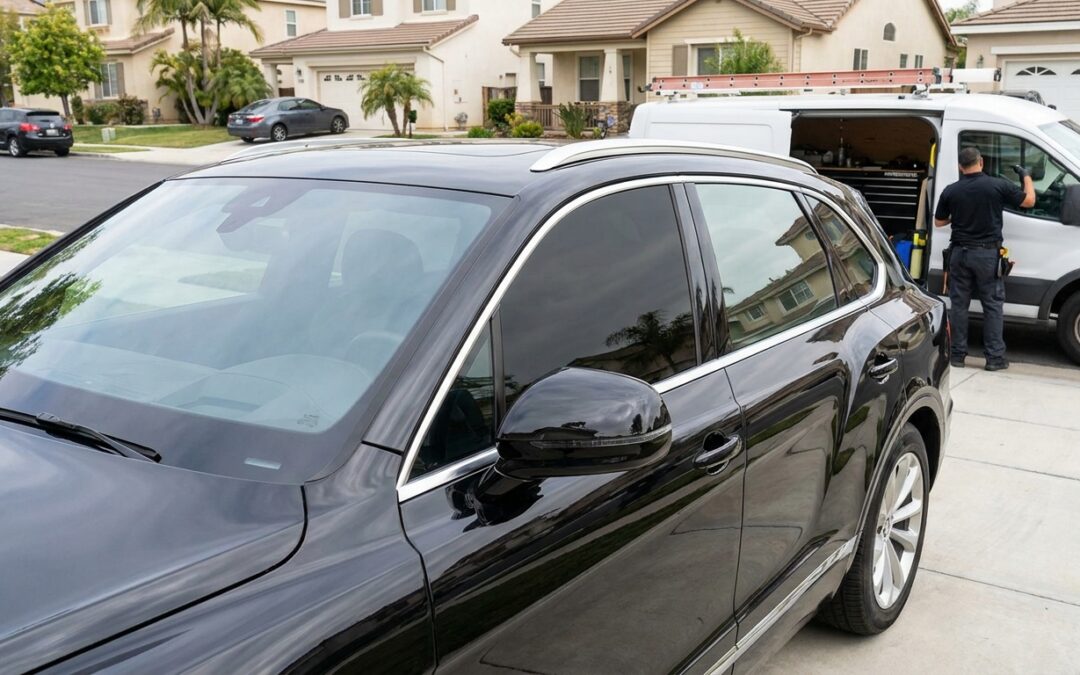
Legacy Mobile Tints brings professional window tinting directly to you. Whether you are at home or at work, our team sets up a controlled environment to install your film cleanly and efficiently. We serve vehicle owners across the Los Angeles area, including Pasadena, Glendale, Burbank, Arcadia, Alhambra, Monterey Park, Montebello, South Pasadena, and San Marino.
If you want to see examples of our clean installations on luxury sedans, sports cars, SUVs, and trucks, feel free to check out the gallery of our work.
Convenient Mobile Services in Your Neighborhood
Driving to a shop, waiting in a lobby, or arranging a ride back home takes unnecessary time out of your day. With mobile window tinting, your car gets tinted while you work, relax, or spend time with family.
We frequently provide mobile car tinting in Pasadena, Glendale, Burbank, and Arcadia. Our mobile units bring all necessary tools, computer-cut film patterns, and top-tier ceramic products directly to your driveway or parking space.
Request Your Mobile Window Tint Quote Today
Not all ceramic tints are created equal. Investing in a high-grade ceramic film ensures superior heat rejection, clear visibility, and long-lasting durability. Pair that with convenient on-site installation, and you get a stress-free experience from start to finish.
Ready to upgrade your ride with premium carbon or ceramic tint? Call Legacy Mobile Tints today at 818-605-5855 or visit our contact us page to request your free mobile tint quote.